


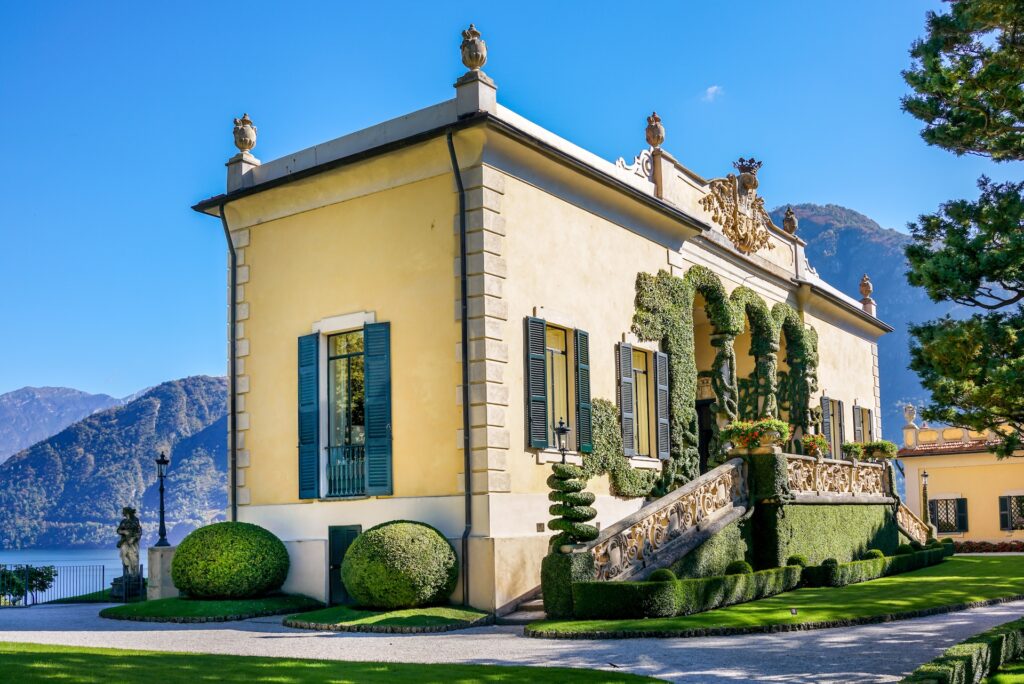
Italian villas do not follow a single template: their design evolved through periods and regional styles. However, one archetypal style that is often synonymous with the “Italian villa” is the Renaissance villa architecture pioneered by Palladio. As described earlier, Palladian villas feature a harmonious blend of classical temple motifs and residential function: porticos with columns and pediments on all sides, symmetric wings, and a central hall often inspired by Roman domes or rotundas. Villa La Rotonda (Capra) is the prime example – “a symmetrical building with a square plan with four facades, each with a projecting portico,” all organized around a circular domed hall. Palladio’s use of mathematical proportion and classical orders in a countryside home was revolutionary, embodying the Renaissance humanist ideal that even a rural retreat should be a work of art reflecting order and beauty. The layout of such villas usually included a piano nobile (noble floor) with grand salons for entertaining, aligned windows and doors for cross-ventilation and vistas, and often hidden service quarters for staff (Palladio, for instance, tucked servant areas in a lower ground floor, accessible by concealed stairs).
One hallmark of Italian villa design is the emphasis on integrating indoor and outdoor spaces. Loggias, open courtyards, terraces, and gardens are common features, allowing residents to enjoy the landscape and climate. In a Mediterranean setting, a villa was as much about the outdoor living – the vista over vineyards or olive groves, the shaded portico for afternoon leisure – as about the interior. For example, Palladio designed the loggias of La Rotonda specifically so that from each one “views of the surrounding countryside can be seen,” making the landscape part of the architecture. This was a contrast to, say, medieval castles or even some northern European manors that were more inward-focused or defensive. The Italian villa typically has extensive gardens – indeed, the Italian Renaissance garden style (symmetrical layouts, fountains, statues, terraces) was developed in tandem with villa architecture (e.g. Villa d’Este’s famed gardens). These gardens further blur the line between built space and nature.
Several other architectural styles represent Italian villas across eras:
Medieval and Tuscan Farmhouse Villas
In some regions like Tuscany, what became known as villas were actually fortified farmhouses or masserie upgraded by landowners. These have a rustic stone or brick aesthetic, with multiple levels, a central courtyard, and often a tower or defensive features (remnants of less secure times). They emphasize thick walls, small windows (for heat and security), and loggias. Many have been converted into luxury rustic villas today, prized for their “fascino rurale” (rural charm).
Baroque and Neoclassical Villas
In the 17th-18th centuries, villas, especially around Rome and Naples, took on Baroque grandeur – think lavish facades, grand staircases, and ornate reception rooms (e.g. Villa Farnese at Caprarola with its pentagonal plan and frescoed interiors). By late 18th to 19th century, Neoclassical influence (some via Palladian revival) meant many villas sported classical pediments, symmetry, and formal axial layouts in gardens. The Villa Reale in Monza or Villa Manin in Friuli are examples of grand Neoclassical villas.
Liberty and Early 20th-Century Villa
The Liberty style (Art Nouveau) around 1900 left Italy with some elegant villas characterized by floral motifs, turrets, and large windows (like the villa in Lerici, Liguria cited earlier). In the 1920s-30s, rationalist and eclectic styles produced villas that mixed modern simplicity with Deco or historicist touches – for instance, Villa Necchi Campiglio in Milan (a 1930s Art Deco villa) or the many Lake Como villas updated in the Belle Époque.
Contemporary Villas
Today’s new-built “villas” in Italy often blend modern architecture with traditional elements. Large single-family homes (especially in suburban areas of northern Italy) might be called ville, but in a modern context they feature open-plan interiors, big glass windows, and amenities like swimming pools – a different look but still carrying the aspirational label of villa.
Despite this variety, what makes a villa distinctly Italian in style is often the sense of history and setting: an Italian villa, whether a Renaissance masterpiece or a rural farmhouse conversion, typically has an air of classical elegance or rustic authenticity that roots it in the Italian landscape and cultural context. The use of materials like terracotta roof tiles, stone walls, and frescoed interiors are common. Even modern luxury villas in Italy try to incorporate traditional motifs (arched porticoes, Italian garden landscaping, etc.) to capture that villa essence.


The Italian Villa vs. Other European Traditions
On a Europe-wide level, Italian villas have some unique distinguishing features when compared to analogous high-end residences in other countries (such as French châteaux, English country houses, Spanish fincas, etc.). One key difference is historical continuity: Italy’s concept of the villa goes back to antiquity and was revived in the Renaissance, meaning the cultural idea of a villa as a place of leisure, agricultural roots, and classical beauty is especially ingrained in Italy. By contrast, in France, noble country residences evolved into châteaux – often more fortified or monumental – and in Britain the manor house or country house tradition emphasized large blocks and later informal landscape gardens.
Architectural influence
Italian villas, particularly through Palladian architecture, influenced other countries’ designs. For instance, the English Palladian country houses of the 18th century (like Lord Burlington’s Chiswick House) were directly inspired by Italian villas. In the 19th century, the Italianate villa style became wildly popular in Victorian England and America – characterized by square towers, bracketed cornices, and lush gardens to evoke an Italian ideal. This was essentially a romanticized interpretation of Tuscan and Lombard villa architecture. The fact that “Italianate” became a style speaks to how Italian villas were seen as epitomes of cultured living.
Integration with landscape
Italian villas tend to be celebrated for how they merge with their natural surroundings. The Renaissance ideal, as noted, was to place the villa in a commanding but harmonious spot – “in harmony with the landscape” as at Villa Rotonda – often on a hill or overlooking a valley, with deliberate vistas (think of Tuscany’s villas on hilltops with cypress-lined lanes). English country houses of the 18th-19th centuries also emphasized landscape (Capability Brown’s naturalistic parks), but those estates were typically far larger in acreage, creating a park separate from the house. Italian villas usually have more compact formal gardens immediately around the house (the giardino all’italiana) and then working farmland or nature beyond – a blend of beauty and productivity. French châteaux of the Baroque era, on the other hand, often imposed very large geometric gardens (Versailles being the extreme) and were statements of power. Italian villas feel more intimate in scale by comparison, designed for daily enjoyment by their owners rather than purely to impress; even grand ones like Villa d’Este (Tivoli) or Villa Lante have a human-scaled charm alongside their elegance.
Climate and lifestyle
The warm Mediterranean (in much of Italy) influenced villa design – airy loggias, courtyards, tile roofs – versus the steep roofs and closed rooms of Northern European mansions built for colder, wetter climates. An Italian villa embraces indoor-outdoor living: breakfast on a terrazza, strolling the vineyard, etc. In many other countries, country estates might have been more indoor-centric due to weather. This fosters a different feel – la dolce vita atmosphere is part of an Italian villa’s identity, something that distinguishes it and attracts foreigners. For example, a British buyer might note that an Italian villa comes often with a pool, olive trees, and al fresco dining patios that you wouldn’t find in an English manor of similar stature.
Terminology and cultural image
It’s interesting that the word “villa” itself is Italian and is used internationally to denote a luxury house. In places like France or Spain, one might use villa to mean a modern vacation house (e.g. on the Côte d’Azur any standalone house might be called a villa today), but the Italian usage carries a historical weight. A Spanish aristocrat’s country home might be called a finca or cortijo, and in German princely estates were Schlösser (castles) or Herrenhäuser. The Italian villa implies a certain classical refinement rather than feudal power or purely rural function. This heritage makes Italian villas stand out – they are living pieces of art and history, not just large homes. Many are protected by heritage laws, whereas in other countries fewer private homes are so ancient or artistically important as to be nationally treasured.
In sum, an Italian villa is often set apart by its classical design, harmonious landscape integration, and cultural legacy. Other European luxury residences have their own grandeur, but Italy’s villas combine art, architecture, and agrarian tradition in a unique way. That said, nowadays the differences can blur – ultra-rich buyers renovate villas in France or Spain to include Italianate gardens, and Italian luxury villas can have French or English interior décor. But historically, the Italian villa is the prototype that inspired much of Europe’s villa-like architecture, which is why owning an Italian villa is seen as owning an authentic original piece of that heritage.
Features of Italian Villas for Foreign Buyers
Italian villas have long attracted foreign buyers, and in recent years Americans have become the leading international purchasers of luxury properties in Italy. There are several features and selling points of Italian villas that cater especially to these overseas clients.
Historic Charm with Modern Comfort
Many foreign buyers – Americans in particular – are enchanted by the idea of a historic Italian villa (be it a 300-year-old Tuscan farmhouse or a Renaissance palazzo) but also expect modern amenities. Italian properties on the market often respond to this by being restored or upgraded. For example, Americans often seek “casali ristrutturati” – characteristic Tuscan country houses that have been renovated to combine rustic charm with contemporary comfort. Thick stone walls, wooden beam ceilings, and antique fireplaces might be preserved, while adding modern kitchens, updated plumbing/electric, high-speed internet, air conditioning, and security systems. This blend of old-world atmosphere with convenience is a huge draw. Private pools are particularly popular – a villa with a pool is highly desirable for Americans used to this amenity, and many Tuscan and Umbrian villas now boast infinity pools overlooking olive groves, for instance. Similarly, features like ensuite bathrooms (not common in original farmhouses) are often added during renovations to meet foreign expectations of luxury.
Space, Privacy, and Land
Compared to city apartments or villas in other countries, Italian villas often come with substantial land parcels – something foreign buyers value for privacy and recreation. Americans, who are accustomed to more space, find that in Italy they can purchase an estate with acres of land, gardens, and even vineyards or olive orchards. In Tuscany and Umbria, it’s common for a villa to include vineyards or olive groves, allowing the owner to produce a small private batch of wine or oil – a romantic notion for many. As one luxury real estate report noted, “these properties often include large land, pools, vineyards and olive groves, offering an exclusive and private experience” to the owner. Such estate-like features cater to Americans’ idea of a dream Tuscan villa where you stroll through your vineyard at sunset. Moreover, foreign buyers often appreciate having guesthouses or multiple buildings on the property – Italian villas often have annexes (like former barns, caretaker’s cottages, or dependance buildings) that can be turned into guest accommodations, staff quarters, or hobby spaces, which aligns with the needs of buyers who may host family and friends from abroad.
Scenic and Cultural Lifestyle
The Italian lifestyle that comes with a villa is a huge selling point. American clients are drawn to the “beauty of the landscape, the cultural heritage, and quality of life” in regions like Tuscany. An Italian villa offers a lifestyle upgrade: waking up to vineyard views, enjoying local wine on the terrace, proximity to art cities and quaint villages, a slower pace of life, fresh regional cuisine – essentially, la dolce vita. Many American buyers specifically look for villas in areas that offer this idyllic experience. According to an Italian luxury property broker, the top motivations for Americans buying in Tuscany include the breathtaking natural scenery, the rich art and history, excellent food and wine, and the relaxed, healthy lifestyle. Unlike back home where a large house might be in a suburb, an Italian villa can be in a UNESCO World Heritage landscape (like Val d’Orcia) or just minutes from Renaissance towns. This cultural immersion aspect – having a piece of Italian heritage – is a feature no modern mansion elsewhere can replicate.
Investment and Prestige
For some foreign buyers, an Italian villa is also seen as a status symbol and investment. Owning a historic villa in Italy carries prestige – it’s something distinctive among global luxury properties. There’s also financial sense in some cases: high-end Italian real estate has been viewed as a stable store of value (Italy’s prime property market is “less volatile than many others, offering more stability” ). Americans who buy villas sometimes do so as a long-term investment or rental property (e.g. to rent out as a luxury vacation home). About 25% of luxury property buyers in Italy are foreigners, mainly Americans, indicating international confidence in Italian real estate. Many Americans have been encouraged by a favorable dollar-to-euro rate in recent years and by Italy’s tax incentives (like the flat tax regime for wealthy relocators). In fact, industry reports note a surge of American buyers in regions like Tuscany in the last couple of years. Americans see Italian villas as relatively good value compared to domestic options in, say, Napa or the Hamptons, and with incomparable cultural cachet.
Tailored Services for Foreigners
Italian villas are often marketed with foreign buyers in mind and thus come with options for turnkey services. Agencies catering to Americans might highlight features such as bilingual property managers, availability of chefs or concierge services, and connections to international schools or expat communities if the buyer plans to reside part-time. Americans typically prefer that bureaucratic tasks are handled by professionals – things like getting renovation permits, hiring local contractors, or managing staff for the villa. As we will discuss in the next section about IRECOM, a whole ecosystem exists to assist foreign villa owners. This means an American buyer can expect that even after purchase, they can hire property management to look after the villa year-round (maintenance, gardening, security), which is a big plus for those not living in Italy full-time. In terms of physical features, some villas now quietly include things like smart home systems, home theaters, gyms, and even elevators installed inside historical structures – amenities that American luxury buyers might anticipate. Sellers know their market: for example, wifi coverage across the property and air conditioning in bedrooms are frequently installed in restored villas to meet foreign expectations (whereas a decade or two ago, many Italian sellers didn’t consider AC essential in old stone houses).
To summarize, Italian villas offer foreigners – especially Americans – a mix of romance and practicality: you get the storybook villa (stone walls draped in bougainvillea, centuries of history, panoramic views) plus modern luxury (pool, high-end appliances, security, broadband internet) to ensure comfort. It’s a combination that has made Italy the top dream home destination for many affluent international buyers. That demand is clearly reflected in market trends: U.S. buyers now outnumber all other nationalities in Italy’s prestigious property segment (almost 30% of inquiries on one international portal were from Americans, far ahead of UK or German buyers). Whether as a personal lifestyle choice or an investment to rent out to vacationers, an Italian villa holds a special allure for foreigners seeking both a tangible asset and an aspirational experience.
The Italian Villa Market Today: Trends and Regional Comparisons
The current real estate market for villas in Italy is dynamic, shaped by both domestic demand and significant foreign interest. Let’s delve into updated data (as of 2024-2025) to understand where the villa market is most active, where the highest and lowest prices are, and what opportunities exist for buyers – including those hunting for relatively “cheap” villas. Below are some comparative insights and data tables highlighting key aspects of the Italian villa market.
Market Size and Activity: Overall, Italy saw a strong post-pandemic surge in home sales, including country homes. In 2021, for instance, transactions rebounded sharply – a notable case, luxury agency Great Estate recorded a +125% increase in sales of villas and farmhouses in Tuscany and Umbria compared to the prior year. Nationwide statistics show continued growth in 2022 and a steady high level into 2024. By sheer volume, Lombardy is the largest real estate market (accounting for about 1 in 5 home sales), followed by Lazio (~1 in 10), then regions like Veneto, Emilia-Romagna, and Tuscany. However, when it comes to villas and luxury country properties specifically, the picture is a bit different – regions like Tuscany, Umbria, and Liguria punch above their weight due to high demand from both Italians and foreigners for second homes there.
Top Regions for Luxury Villa Sales: Recent data from the Luxforsale Observatory (covering May 2022-Sept 2023) on properties ~€1.6M and up shows Tuscany and Lombardy leading in the number of luxury home transactions. Below is a summary of the top five regions in that segment:
| Region | Luxury Properties Sold (May 2022-Sep 2023) |
| Tuscany | 698 |
| Lombardy | 648 |
| Liguria | 322 |
| Umbria | 224 |
| Lazio | 184 |
In terms of cities for luxury deals, Milan and Rome unsurprisingly top the list (121 and 83 properties sold above ~€1.6M, respectively), but interestingly Monza (adjacent to Milan) came in third with 50, and Olbia in Sardinia fourth with 39. This shows that outside the big two cities, wealthy buyers focus on select luxury enclaves (Monza for villas in the Milan area, Olbia for the Costa Smeralda villas).
Price Levels by Region
Italy’s real estate prices vary enormously by region. For a broad view, the table below compares the most expensive and most affordable regions on average (all property types, which reflects general villa cost differences too):
| Most Expensive Regions (2025 avg. price per m²) | Price €/m² | Most Affordable Regions (2025 avg. price per m²) | Price €/m² |
| Liguria (NW coast) | ~2,881 | Calabria (southern tip) | ~954 |
| Lazio (Rome and region) | ~2,732 | Molise (south-central, small) | ~1,075 |
| Valle d’Aosta (Alpine) | ~2,661 | Basilicata (south, rural) | ~1,184 |
For villas specifically, the pattern is similar. Villas in areas like coastal Liguria, the Tuscan countryside, or Lake Como command high prices per square meter (often well above €3,000/m², and in ultra-prime cases €8,000-€10,000+/m² for something like a lakefront mansion or a seaside villa in Capri). On the other hand, a countryside villa in say rural Calabria or inland Sicily might be amazingly cheap – sometimes under €1,000/m², or a large country home for the price of a tiny Rome apartment. In fact, within regions there are big disparities: e.g., Sicily overall is mid-range, but its provinces include some of the cheapest in Italy (like Caltanissetta and Agrigento) as well as expensive pockets (Taormina, Palermo’s Mondello, etc.). A survey of provinces put Biella (Piedmont), Caltanissetta (Sicily) and Agrigento (Sicily) as the least expensive areas – Biella’s average was only ~€715 per m², illustrating how certain non-touristic, post-industrial or rural zones can be very low cost for large homes.
Where are villas most in demand?
The regions seeing the most transactions of villas/country homes align with where foreigners and affluent Italians want to be. Tuscany and Umbria have been extremely dynamic – as noted in 2021 data, Umbria and Tuscany were the top targets for buyers seeking a “safe haven” rural retreat, a trend amplified by the pandemic push for space. In Great Estate’s 2021 sales, Umbria accounted for 52 villa/casale sales and Tuscany 47, dwarfing other regions (only 2 in Lazio and 1 in Marche for that network). This suggests that central Italy (with relatively good value compared to, say, Chianti a decade ago, and lots of stock on the market) has been very active. On the luxury front, we saw Tuscany, Lombardy, Liguria leading in the 2022-23 period. Also, Puglia has been up-and-coming for foreign buyers – its combination of lower prices, seaside masseria estates, and unique trulli has attracted North Europeans and some Americans. Regions like Piedmont (especially the Langhe wine hills) and Le Marche are also cited as offering good value for those willing to go slightly off the beaten path; they have beautiful villas at prices lower than Tuscany but similar appeal (wine country, scenery).
Where can you find “bargains” or cheap villas?
If by cheap we mean under, say, €200,000, these will almost exclusively be in less developed regions (or be properties requiring significant renovation). Italy periodically makes headlines with its “€1 homes” in depopulated villages – while those are usually townhouses, not stand-alone villas, they illustrate the opportunities in certain areas. Regions like Calabria, Molise, Basilicata, inland Sardinia, and parts of Abruzzo and Sicily are ripe for bargain hunters. For example, in Molise or Calabria, one might find a habitable country house (villa by local standards) for under €100,000 – something nearly impossible in the north or center. Even in Tuscany, if one goes to less touristy provinces (say the mountains of eastern Tuscany) there are lower-cost options, but generally Tuscany and Umbria have appreciated thanks to foreign demand.
Possible to buy a low-cost villa?
Yes, but with caveats. Italy’s most affordable regions (Calabria, Molise, etc.) do offer low prices – e.g. Calabria is the “most affordable region in Italy” at ~€954/m² on average. That implies you could, in theory, buy a 200 m² countryside villa in Calabria for under €200k (and indeed listings at even half that can be found for older homes). However, condition is key – many cheap properties need renovation. There are stories of foreigners buying a rustic farmhouse for a song, then spending twice that amount on making it livable. Some regions (Abruzzo, for instance) have plenty of semi-restored farm villas on sale for relatively cheap, targeting foreign buyers who want a project. It’s also worth noting that Sicily and Puglia have a bifurcated market: coastal luxury vs. inland bargain. A sprawling historic villa in rural Sicily might be surprisingly cheap relative to its size, since demand is lower there than for, say, a Tuscan equivalent. An example: one could find a Baroque villa in the Sicilian interior for a fraction of the cost of a similar-size villa in Florence – but the trade-offs come in what we discuss next.
Infrastructure, Services, Accessibility – the Downside of “Cheap” Villas
The old adage “you get what you pay for” often holds true in real estate. When a villa is very cheap, it’s usually cheap for a reason related to location and convenience. Often these properties are in remote, economically depressed areas. That means infrastructure and services are limited: the roads to reach the house might be poor (or the house is far from the autostrada exit), public transport is scant, and even essential services like large supermarkets, hospitals, or reliable utilities can be far away. As a real estate advisory article notes, if a second home is “located far from your primary residence or requires long travel times, it may prove less functional and less profitable in the long run”. Many ultra-cheap villas are located in hilltop villages that have lost population – beautiful but somewhat isolated. One must consider: How far is the nearest airport? If you plan to attract international guests or use it frequently from abroad, a 4-hour drive from Rome or Milan airports can be a deterrent. What about healthcare? Retirees moving to Italy will want a hospital within an hour, for example. Shopping and daily needs: A quaint farmhouse that’s a 30-minute drive down mountain roads to buy groceries may not be practical for everyone. A professional investment guide suggests that “the presence of nearby services, transport, and attractions is fundamental to ensure good rental yields and convenience”. If those are lacking, the property’s utility and resale value suffer.
Furthermore, renovation and maintenance costs on an older villa can be very high – sometimes exceeding the purchase price. Buyers of cheap villas must budget for structural repairs, bringing systems up to code, and ongoing maintenance (an old roof, large garden, etc., all cost money). And since appreciation in very rural areas is low, a “cheap” villa is not a great flip investment; it’s more of a lifestyle purchase. Real estate experts caution that if an area doesn’t have growth drivers (tourism, economic development), property values might stagnate or even decline, so one shouldn’t count on capital gains just because the home is in Italy. In short, buying a cheap villa in Italy is quite different from buying in a prime area – it can be wonderfully rewarding if one truly wants the tranquility and is willing to handle the logistics, but it’s not a straightforward profit-making investment. It’s essential to do due diligence: check title and legal issues (some old properties might have tangled inheritance histories), ensure you understand the renovation permissions (Italy has strict rules especially if the building is historic or in certain zones), and ideally have local contacts.
To illustrate, consider two scenarios: (1) a €100k 5-bedroom country house in a remote Calabrian village; (2) a €1M 5-bedroom villa in Chianti. The first might seem a bargain, but it may take 2-3 hours to reach from a major airport, you might struggle to find an English-speaking contractor or property manager nearby, the area might lack high-speed internet or international schools (if moving with family), and renting it out to tourists could be tough unless it’s near a known attraction. The Chianti villa, while 10 times the price, is an easier “investment” in that Tuscany is perennially popular, services (fine dining, wine tours, maintenance companies) abound, and liquidity is better (resale demand is high). Thus, when buying a cheap villa, one must account for the “hidden costs” of its cheapness – both monetary (renovation, higher maintenance due to age) and lifestyle (relative isolation, effort to manage). An Italian property blog aptly notes that one should evaluate “practicality of use” for a second home: if it’s too remote or hard to maintain, it may “prove less functional and less profitable” over time.
That said, for certain buyers – perhaps those looking to live off-grid or pursue a passion project like restoring an old mill – these cheap villas are ideal. Italy offers a diversity of options: you can spend €10 million on a fully-restored luxury villa in Lake Como, or €50,000 on a rustic farmhouse in Abruzzo that you fix up yourself. Neither is “better” outright; it depends on the buyer’s goals. Just remember that the lower the price, likely the higher the involvement needed post-sale to make the villa comfortable. As a final tip, potential buyers of affordable villas should research if the area has any incentives or if it’s part of a redevelopment initiative (some regions offer tax breaks for restoration in certain towns, etc.), and consider hiring a local geometra (surveyor) to inspect the property.
IRECOM – The Italian Real Estate Company – Your Villa Buying Partner
Purchasing a villa in Italy – especially a high-end or historic one – is not as simple as clicking “add to cart.” It’s a complex journey requiring local expertise, and that’s where specialized agencies like IRECOM (Italian Real Estate Company) come into play. IRECOM is a Florence-based real estate consultancy that focuses on prestigious properties (particularly villas and estates) and provides end-to-end services tailored for international clients. In other words, it acts as a property finder, advisor, and project manager all in one, catering to buyers who want a smooth experience in acquiring and managing an Italian home.
Full-Service Team
IRECOM distinguishes itself by assembling a “dexterous team of accomplished multilingual professionals” to assist foreign investors at every stage. This team includes experienced real estate agents and brokers, but also surveyors, architects, engineers, accountants, lawyers, and property managers. Why so many specialists? Because buying a villa in Italy can involve a gamut of issues – from evaluating the structural condition (hiring an engineer), to navigating zoning laws and restoration permits (needing an architect and legal permits), to handling contracts and taxes (lawyers and accountants), and eventually managing the property (property managers for rentals, maintenance, etc.). IRECOM’s philosophy is to offer a “single point of contact for everything: property search, legal and tax assistance, renovation, and full property management”. This one-stop-shop approach is incredibly valuable to foreign buyers who may not speak Italian or know the local processes. Instead of the client individually finding a lawyer, a contractor, a translator, etc., the agency coordinates it all. As IRECOM states, their multilingual staff (fluent in English, Spanish, Chinese, Arabic among others) bridges any communication gaps and “guides you through every step” ensuring all your needs are met.
Specialization in Lombardy and Central Italy (and beyond)
IRECOM is based in central Italy and has particular expertise in cities like Milan, Bologna, Lucca and regions like Tuscany and Umbria – regions where they’re on home turf and where many luxury villas are located. These areas are indeed described as the agency’s core focus, benefiting clients who wish to buy in popular zones like Chianti, Florence countryside, Siena, Perugia, or Lake Trasimeno. That said, IRECOM’s reach isn’t limited to those regions; they have networks and partners across Italy’s key markets (their site and materials also discuss properties in Lombardy, Veneto, Puglia, Sicily, etc. as part of their offerings ). So whether one wants a farmhouse in Tuscany or a seafront villa in Sardinia, a company like IRECOM has the connections to find suitable options. They act as property finders, meaning they don’t just push what’s on their own listing sheet but will actively hunt for a property that fits the client’s preferences (even if it’s an off-market sale). For American clients in particular, who often aren’t physically present in Italy until the final stages, this kind of personalized search is crucial – the agency can shortlist properties, provide virtual tours, and give honest evaluations.
Navigating Bureaucracy and Legalities
One of the biggest value-adds of IRECOM is helping buyers navigate Italy’s bureaucracy and legal framework. Italy has quite a few layers of bureaucracy in real estate – for example, verifying title and absence of liens, ensuring the building is compliant with planning permission, handling the preliminary purchase contract (compromesso) and notary deed, understanding tax implications (like registration tax, cadastral tax, ongoing property taxes), and if the buyer isn’t an EU citizen, possibly assisting with visas or special residency programs (like the Elective Residency Visa or the flat-tax regime for new residents). IRECOM provides “expert guidance through every step: legal checks, tax consultancy, technical due diligence, visa support…”, according to their service description. This is invaluable, because an unwary foreign buyer could easily stumble on pitfalls – such as buying a rustic villa only to find out later part of it was built without permit 30 years ago (common issue) and needs amnesty, or discovering that the gorgeous property has an archaeological constraint or some easement. The agency’s role is to preempt those issues by thorough due diligence. They also can estimate renovation costs and manage renovation via their network of architects and contractors, which is a huge relief to someone not familiar with local construction. As IRECOM points out, restoring a vintage property can be “gratifying but also complex,” so they offer to “bring new life to your property” by overseeing restoration from design to furnishing. Essentially, they can take an old farmhouse and deliver it turnkey as per the client’s wishes.
After-Sale and Management
Unlike a typical real estate agent who disappears after the sale closes, IRECOM and similar firms often provide post-purchase services. This includes property management (security, cleaning, maintenance, pool upkeep), help with setting up utilities, hiring staff, or even managing rentals if the owner wants to rent the villa seasonally. IRECOM mentions offering flexible solutions to make property ownership smooth and even partnership with property management specialists. For foreign owners who might only vacation periodically at their villa, knowing that someone local is keeping an eye on the place and handling day-to-day issues is essential.
Why you need a team for villa transactions
As the prompt suggests, “villas are objects that cannot be bought like walking into a shop or on a normal listing site”. Indeed, many of the best Italian villas are not even publicly listed – they’re sold via networks, contacts, and specialized agencies. It’s not uncommon that a high-end villa sale is done semi-discreetly to protect seller privacy. Therefore, having an agency plugged into the market ensures you get access. Furthermore, the process of buying and eventually possibly renovating a villa involves many technical and legal steps. From land surveys, seismic checks (Italy is an earthquake-prone country, so an engineer might need to assess structural integrity), to dealing with vincoli (heritage or landscape constraints), to securing permits if you plan changes – it’s a gauntlet that can intimidate even locals. For example, if your dream villa has a crumbling 17th-century wing, you’ll need the local Superintendence of Fine Arts’ approval to alter it. If you want to add a swimming pool, you must get local commune permission (and sometimes archaeological clearance). Without a knowledgeable team, a foreign buyer could end up with nasty surprises or bureaucratic nightmares.
Agencies like IRECOM essentially de-risk the purchase for foreigners. They perform pre-purchase checks, advise on fair pricing (important in an often illiquid luxury market), and strategize negotiation. They also often coordinate with banks if a mortgage is needed, though many luxury buys are cash. Another advantage: they can educate buyers on regional nuances – for instance, explaining why a villa in one Tuscan valley costs double a similar one in another (maybe due to better infrastructure or tourist appeal), or guiding them on which areas have the best investment potential. This consultative role means the client makes an informed decision aligned with their goals (be it lifestyle or investment).